Chapter 7 of 11
Gathering & Crafting
Wood, ore and aether become bows, armor, jewelry and enchantments.
Lumberjacking
Tap a tree to chop it. Each chop has a 35% chance to cut logs, plus 0.5% per point of Lumberjacking, and you cut more logs per chop as your skill grows. Each tree holds a few logs. A felled tree grows back after about a minute. Logs sell for 2 gold and feed carpentry.
Carpentry
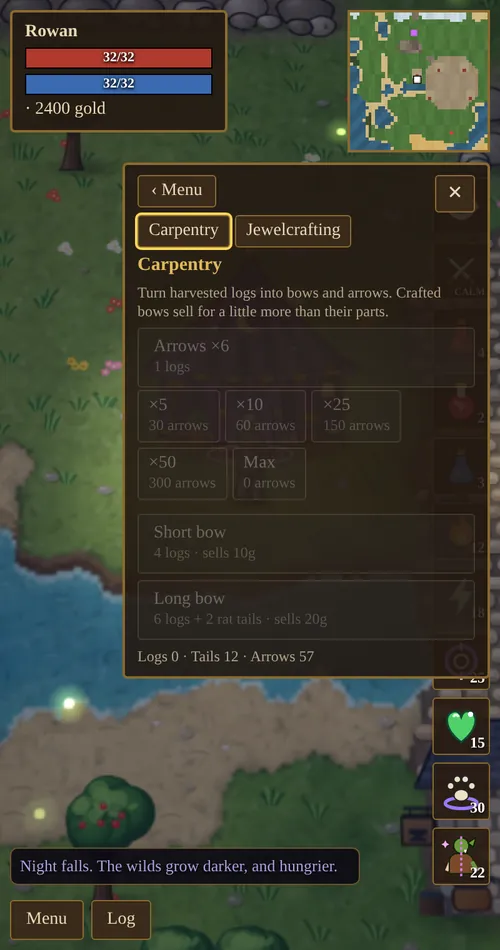
Menu → Craft → Carpentry turns logs into bows and arrows. No skill is needed.
| Make | Needs | Notes |
|---|---|---|
| Arrows ×6 | 1 log | You can make arrows in bulk. |
| Short bow | 4 logs | Range 6, +3 damage. Sells for 10g. |
| Long bow | 6 logs, 2 rat tails | Range 8, +6 damage. Sells for 20g. |
Mining
Buy a pickaxe from Mara for 45 gold, then tap an ore vein to mine it. Veins are found in the four mines and in a rubble pile just outside town. Each vein holds a few loads of ore and crumbles when it runs out.
Your chance depends on your Mining skill, the ore’s difficulty and your Strength. Mining is noisy: monsters within 12 tiles hear you and come looking.
| Ore | Mining skill to work well | Ore sells for | Smelting needs | Gear strength |
|---|---|---|---|---|
| Iron | 0 | 8g | 0 | ×1.00 |
| Copper | 12 | 16g | 8 | ×1.12 |
| Silver | 28 | 34g | 17 | ×1.28 |
| Gold | 46 | 70g | 27 | ×1.46 |
| Platinum | 66 | 140g | 39 | ×1.66 |
| Mithril | 84 | 300g | 51 | ×1.90 |
Below the listed skill you can still try, but you mostly scratch the rock. Rarer ore is found deeper in the mines.
Smelting and smithing
Inside Garrick’s smithy, tap Use the forge. Smelt turns ore into ingots; it needs Blacksmithing of at least 60% of the ore’s smelting level and teaches more for rarer ore. Craft forges gear from ingots.
Gear made from a better metal is stronger: a mithril piece has 1.9× the damage or armor of an iron one. Each piece has a success chance shown on its button. A failure warps the piece and costs half the ingots. One forging in twenty comes out Exceptional, with up to 40% extra strength depending on your Arms Lore.
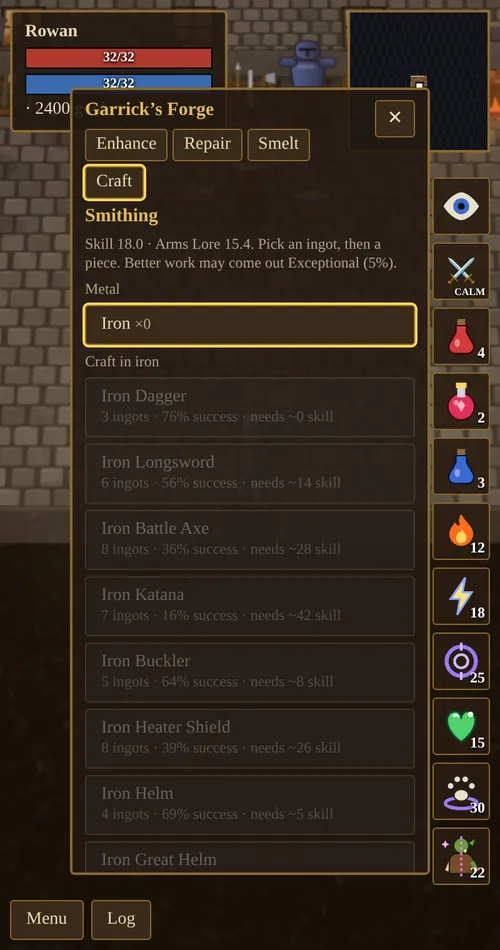
| Piece | Ingots | Difficulty |
|---|---|---|
| Dagger | 3 | 0 |
| Helm | 4 | 5 |
| Boots | 4 | 8 |
| Buckler | 5 | 8 |
| Brigandine | 6 | 10 |
| Longsword | 6 | 14 |
| Great Helm | 6 | 20 |
| Heater Shield | 8 | 26 |
| Battle Axe | 8 | 28 |
| Greaves | 8 | 30 |
| Chainmail | 12 | 36 |
| Katana | 7 | 42 |
| Plate Armor | 20 | 62 |
Each button shows your success chance. You have about a 50% chance when your Blacksmithing equals the piece’s difficulty plus 90% of the metal’s smelting level, and better odds above that. For example, a copper longsword (14 + 11) is an even bet at about 25 skill. The finest pieces in the rarest metals stay risky even for a master smith.
Jewelcrafting
Menu → Craft → Jewelcrafting makes a ring (2 ingots) or a necklace (3 ingots), with an optional gem: ruby, sapphire, emerald or diamond. A failure cracks the setting and costs one ingot.
New jewelry has no bonuses. Its value is in what it can hold: a better metal and a better gem let it take stronger enchantments and more of them, up to three. Take it to the enchanter’s table.
Enchanting
Archmage Ilvara’s tent has an enchanter’s table that binds aether into gear. Aether drops from monsters in dungeons, and bosses drop several.
- You can enchant ordinary, non-magic gear and jewelry you have made. Magic items and gifts cannot be enchanted.
- You can only add properties you have seen. Identify magic items with Arms Lore to learn what they hold: Strength, Dexterity, Intelligence, damage percentage, or any skill except Begging, Arms Lore and Enchanting.
- Each item has a maximum power and a number of slots. Ordinary gear has 1 or 2 slots, and jewelry up to 3. Choose one of three power levels; stronger enchantments cost more aether (2 + power) and are more likely to fail.
- A failure costs half the aether. A success renames the item, for example “Silver Ring of Might”.